Total Pageviews

Saturday, July 30, 2016

Nickerson State Park, New York 2016


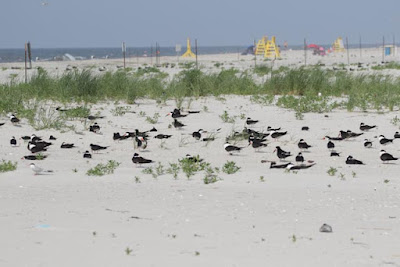
Nickerson State Park is on Lido Beach, NY (Long Island).  Here hundreds of American Oystercatchers, Black Skimmers, and Common Terns gather to nest. They are separated from the beach, and people by a rope line. Along the shore  can be found Great Black-Backed Gulls, Herring Gulls, and Ring-Billed Gulls.  I went there to take part in an Instructional Photo-Tour (IPT) run by Arthur Morris an internationally recognized bird and nature photographer (http://www.birdsasart.com).

Beach with Skimmers in the foreground. 
 Skimmers and chicks


Birding began before 5AM. The following was taken around 7:30 AM:
Oystercatchers: 


Common Tern adults, fledglings and chicks: 


Success!


We found a nest with two chicks that were  two or three-days old. They still had their egg teeth. The next day one of the parents was brooding a dead chick, and the other was gone. Not sure if it was a predator (feral cat or raccoon) or a sandstorm. During the night the wind  gusted to 30 mph.

Yes-it swallowed the whole thing, and then came back for more.


Thursday, July 28, 2016

Chatham (MA) Mini-Pelagic

The following account was submitted by guest blogger, Kristen Johnson.


On Sunday, July 24, the “Kittiwake” left the Chatham Fish Pier at 7 AM for a 4-hour mini-pelagic with seven passengers aboard.  The boat sped quickly away from Chatham to a location about 7.5 miles from shore.  There we slowed down and began to look for birds.  Shortly thereafter, a Cory’s Shearwater was spotted.  This species proved to be the most numerous shearwater during the trip.  
Cory's Shearwater

Cory's Shearwater

Cory's Shearwater

Great Shearwater
As we drifted around we found a Great Shearwater, and eventually a Sooty Shearwater flew by.  Then we went by two Manx Shearwaters sitting on the water.  We had then easily picked up all four expected species of shearwaters.  Wilson’s Storm Petrels were also common in these waters.  At one point a jaeger flew by but was too fast for photos and a positive ID, although it was most likely a Pomarine.
Two Manx Shearwaters


 We watched the shearwaters for a bit and then started chumming to bring them in closer.  At this time, there were few gulls in sight, but once they smelled the fish, they appeared.  About 20 gulls circled the boat.  The storm petrels and the gulls really liked the chum.   Some Sooty Shearwaters also came in, but the Cory’s did not.
Sooty Shearwater

Wilson's Storm-Petrel
Wilson's Storm-Petrels

The captain and the trip leader saw two Humpback Whales in the distance and decided to move closer.  The whales were bubble-feeding and attracting a large group of gulls.  At times, a gull even sat on a whale!  The whales put on a great show, coming quite close to the boat.  At this time we were estimated to be about 10 miles offshore.  We watched the whales and shearwaters and then slowly traveled away, still watching for shearwaters.
Humpback Whale showing baleen

Humpback Whale Bubble Feeding
Whale diving approximately 100 ft from the boat

Whale diving into the depths

Whale Tail
Some of the sandbars off Chatham, close to the dock, were piled with Gray Seals.  They were swimming in the waters around the fish pier as well.

The estimated numbers of each species were:
White-winged Scoter  2 
Cory’s Shearwater  450
Great Shearwater  12
Sooty Shearwater  20
Manx Shearwater  8
Wilson’s Storm-Petrel  800
Double-crested Cormorant  7
Jaeger sp.  1
Laughing Gull  35
Herring Gull  400
Lesser Black-backed Gull  1
Great Black-backed Gull  300
Common Tern  125

If you are interested in taking a trip like this, see
http://capecodbirds.org/chatham-pelagics/    for more information.  To check recent sightings, the ebird hotspot for these trips is named “East of Chatham.”

Tuesday, July 5, 2016

Regal Fritillary Wildlife Event at Fort Indiantown Gap 7/2/16

         
Male Regal Fritillary
          For the second year in a row Sharon and I made the journey to Fort Indiantown Gap in Lebanon County for the Regal Fritillary wildlife event. The Regal Fritillary is a large, orange, and black butterfly that was once found commonly throughout the Northeast. It looks like a Monarch Butterfly dipped in chocolate. Grassland destruction/alteration over the past 30 years has reduced its range and abundance. This is the largest population of this species remaining east of Indiana. 219 acres of Training Areas and Ranges have been set aside at Fort Indiantown Gap to conduct research on Regal habitat. In addition over 75 acres of new habitat has been created. All regal occupied habitat is on an active or inactive military range. Regals LOVE Ranges!!! Habitat is created and maintained by repeated, frequent soil disturbance, patchy fires, and stewardship efforts that create a diverse grassland dominated by native herbaceous vegetation. Population is around 1,000 adults and has been secure since monitoring started in 1998.
           We were there on a windy day so the flight was more subdues than last year. We still were able to view a large number of males but in the three hours we were on tour we didn't found a single female. Females hide down in the grasses and the males have to find them in order to mate.
            Besides the Regal Butterfly we also found Aprodite and Great-spangled Fritillaries. 
 
Great-spangled Fritillary (Dorsal View)

Ventral View

          Other species of note were Black, Eastern Tiger and Zebra Swallowtails, Cabbage White, Clouded Sulphur and new for me were Coral Hairstreak and Common Sootywing.
    
Common Sootywing (Internet photo)
             Just like last year all the volunteers were great. They also pointed out various other flora and fauna such as Box Turtles and Ring-necked Snake.
 
Ring-necked Snake

            My favorite part of the trip was when I spotted a Black Rat Snake. I couldn't catch up with it but one of the volunteers managed to grab it and show it to the crowd. 


Rebecca handling the Black Rat Snake
          We were also introduced to many plants and flowers and how they interacted with the butterflies. 
Deptford Pink

         
          The total walk around the fields was about 1.7 miles and lasted about 3 hours. Halfway through the walk we were provided with water. The trip was very well organized and I highly recommend that if you have the chance, sign up. Two more trips are scheduled for July 8th and 9th.

Sharon and other participants


Monday, June 13, 2016

Glen Providence Park Amphibian and Reptile Walk - June 2016


Dusky Salamander - notice flat tail and large hind legs
           I attended a Reptile and Amphibian walk at Glen Providence Park in Media on Saturday June 11th along with eight other folks including Tom Bush from the BCDC. The walk was led by Kyle Loucks, the South East Regional Coordinator for the Pennsylvania Amphibian and Reptile Survey (PARS) – a project to gather valuable data for study and conservation of amphibians and reptiles (“herps”). 
              Kyle started off leading us to a seep, which is a small wetlands area, in search of salamanders. After a few minutes of tossing some rocks in the mucky habitat we were treated to a Dusky Salamander. The Dusky is a lungless salamander that breathes through its skin. The tail is flattened in a vertical direction and the larger hind legs help identify this species.
              We then moved to a small tributary and almost immediately Kyle found a Northern Water Snake fishing on the bottom of the creek. We were able to capture the snake and determine it was a small male.
Northern Water Snake

Out of focus but snake coming up for a breath of air
A somewhat better view

           As we moved to the small lake we were able to spot several species of turtles. We found Red-eared Slider, Red-bellied Slider (Cooter), Eastern Painted Turtle and Yellow-bellied Slider.
Yellow-bellied Turtle - notice the large yellow stripe on face
            We were also treated to Bullfrog, Green Frog and a Pickerel Frog which was captured for two seconds but managed to escape from the grip of Reese, the son of Stephanie our trip organizer. So we found nine specimens of Amphibians/Reptiles which I thought was pretty good, however we missed both Alligator and Crocodile. Better luck next year.

Tuesday, June 7, 2016

Ruby-throated Hummingbird Nest


Have you ever wanted to see a hummingbird nest?  There is one at Haverford College that is easy to view and close to the parking lot.  Kristen and I discovered it on May 14 when the female was still nest-building.  As of June 6, the female is feeding young but still brooding.

Here are the directions:
Park in the South (Visitor’s) Lot at the back left edge.  Walk straight across the grass in front of you and take the nature trail to the left, staying right when the path forks.  At the edge of the road to the other back parking lot and the Haverford College Apartments, there is a blue recycling can.  Stop on the paved path behind the can and look left to the large oak tree across the road.  Line yourself up so that you, the blue can, and the trunk of the big oak tree are all in a straight line.  Follow the trunk up to the first horizontal branch that goes right.  Then take the first left, a vertical branch that goes up to the next smallish right branch that comes out toward you.  Where this branch splits into two parts, one which is more or less straight and the other which takes a little dip, look for the nest cup atop the straight part.  The orange arrows in the photo below will guide you to the nest location indicated by the red arrow.


Depending on your exact position, and that of the leaves blown by the wind, the nest may be partly obscured, but with binoculars it is easy to find if you know where to look.  In the photo below, you can see the female’s tail sticking out the right side of the nest.  A scope will enhance your view but isn’t necessary.  Now that she is sitting on the edge of the cup to feed the young, she will be easier to see.


Note that if you are entering observations into ebird, you are in the DelCo portion of the campus, so please use the Haverford College (Delaware County) marker, even though that marker is in the pinetum.  [By contrast, the pond and adjacent field are in Montgomery County.]

Have fun and enjoy watching our littlest bird.
Sheryl