Total Pageviews

Saturday, September 2, 2017

Rare Bird search in Arizona - Part 3


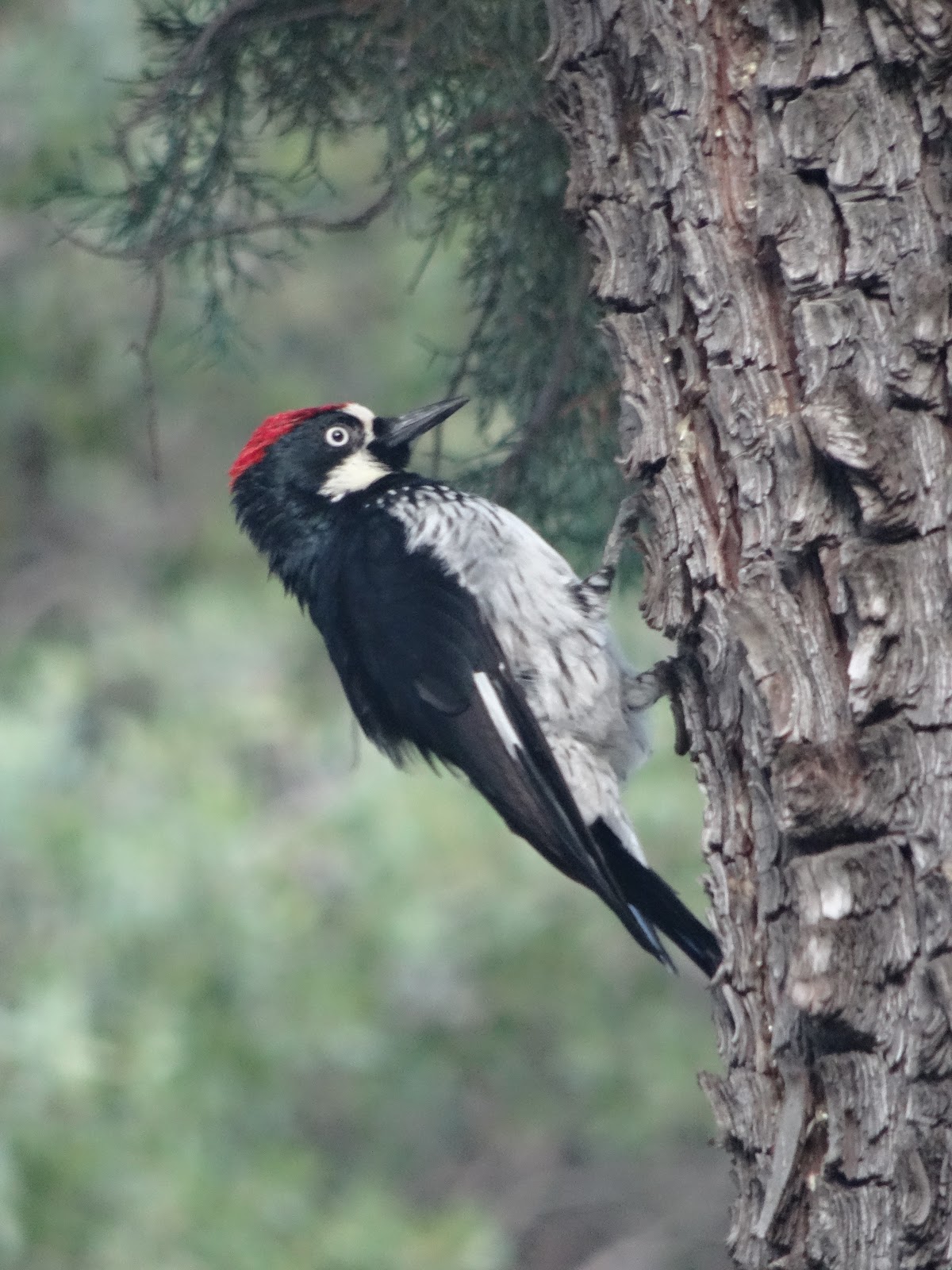
The ubiquitous Acorn Woodpecker
           This morning commenced with a Canyon Wren boisterously singing right outside our bedroom window; an amiable way to wake up. We started out today in Madera Canyon with a energetic walk around the Kubo Cabins and were entertained by Painted Redstarts and a Rivoli's (Magnificent) Hummingbird.
Painted Redstart
Rivoli's Hummingbird
            We then motored (as the English would say) to the top of the canyon and decided to hike up to the Carrie Nation Trail. In the meantime, at the trail head parking lot, the border patrol pulls up with two trucks. A woman and man get out of the truck and the woman threw a M16 machine gun over her shoulder while wearing a kevlar vest and they both started up another trail. By this time we were used to seeing the border patrol so we thought nothing of it.


Border Patrol arrives at trailhead

          We started up the Mt Baldy trail and came to the junction of the Carrie Nation trail and started climbing. We were soon lending an ear to the squeaky toy call of the Sulphur-bellied Flycatcher just ahead. After chasing the family of flycatcher up and down the trail we finally were able to get some photos. This is one cool looking flycatcher.
Sulphur-bellied Flycatcher


            Our main objective however, was to find the Elegant Trogon, which nest up here at around 8000 feet elevation. Following the thrill of observing the flycatcher family's interactions we were then treated to the ventriloquial call of the Elegant Trogon. We meandered up the trail a little further to where I thought the call was emanating and saw a large bird take flight from the trees. It landed further up the trail and we chased it but every time we heard the bird and get close the bird would take flight. I got several great looks at the bird in flight with its bright red belly and long squared off tail but Sharon never did get to see it. We also had a good look at a Blue-throated Hummingbird.

Internet photo of Elegant Trogon
          Leaving the top of the canyon we stopped by the Santa Rita Lodge one more time to take in the feeders. They had an unusual horizontal hummingbird feeder there I had never seen before.

           Around the feeders we spotted Black-chinned, Broad-billed and Rivoli's Humminbirds plus an Arizona Woodpecker and lots of Mexican Jays along with Black-headed Grosbeaks. Much to my chagrin we didn't find a Scott's Oriole,


Black-headed Grosbeak


Broad-billed Hummingbird
Arizona Woodpecker

Mexican Jay
           A little further down the canyon we stopped on Proctor road and were able to get Botteri's Sparrows and found a cute little waterfall.

Proctor Falls

Searching for lizards
Got One!

Desert Flowers

One of many Blooming Barrel Cacti


          As we got lower in elevation we came to Florida (flor-ee-da) Wash where we quickly stopped and heard Botteri's Sparrow on both sides of the road and saw a few. We then headed out of Madera Canyon and went to Florida Canyon where we found the Rufous-capped Warbler a few years back. It was still present but we didn't want to do the hike as it was now noonish and quite temperate. Instead we decided to search for the Black-capped Gnatcatcher which was a complete waste of time.
          Our destination for the evening was the Ramsey Canyon Inn B&B which is located south of Sierra Vista. In order to get there we took the short cut through the mountains following Box Canyon Road. This is a 14 mile long dirt road. In Arizona, you quickly get used to driving on dirt roads. After an hour and a half ride we arrived at the Ramsey Canyon Inn, got our room and started birding the grounds which had a few hummingbird feeders. The Inn is adjacent to the Nature Concservancy's Ramsey Canyon Preserve. Also, if anyone is interested, the B&B is for sale for a mere $1,200,000.
Female Broad-billed Hummingbird

Rivoli's Hummingbird in rear

          Our room at the Inn was called the Rufous. Every afternoon the owner makes a pie for the guests and today's pie was plum and apricot pie. It was quite flavorsome.

           Our main purpose of coming to Ramsey Canyon was in pursuit of the Tufted Flycatcher located in the next canyon south of here. That would be Carr Canyon. The location of the flycatcher was in Reef Townsite campground. I had checked the site several times on google earth and the distance was only about 5-6 miles after entering on the dirt road. I figured it looked like an easy drive. But I never figured the elevation change into the drive. I thought the campsite would be on the same level as the entrance to the canyon, about 4000 feet. Well, what a surprise. The GPS told us it would take 40 minutes to go 5 miles. Something had to be wrong. 
            Well, after coming to the dirt road it looked pretty smooth for the first two miles. Then it started getting windy and started climbing in elevation. After about 3 miles the road changed from dirt to large stones with big ruts and divots. The last mile we were stilling climbing and doing lots of hair pin turns. That last mile took us about fifteen minutes. Finally we arrived just outside the campground entrance and were met by a giant gully across the whole width of the road. We debated rather to park here and walk to the campground or lumber through the trench. We slowly trudged ahead and once the front tires were in the gully there was no turning back. Trying to get out of the gully we could hear the front bumper grinding on the stones, but we made it out. Of course, we had to come back out the same way. 

Near campground - city of Sierra Vista in background


Near campground - city of Sierra Vista in background
          Finally in the campground we started our search. It was around five o'clock in the afternoon when we started our exploration. Unfortunately, storm clouds were out in the distance, but they didn't appear to be heading our way. So we continued our search but to no avail. We kept watching the high clouds but they appeared to be going away from us. Suddenly, through a pass in the mountain close by, some quick moving low clouds came barreling in and the monsoons hit. We immediately started our slow descent down the mountain hoping that we wouldn't slide off the muddy road and off a cliff. But we needed to get down fast because on the way up we had crossed a couple of stream crossings and we needed to get through them before any flash flooding occurred.

Picnic Area in Campground where Tufted Flycatcher was seen most often
         Well as you can see we did make it back in one piece. But the disappointment of not finding the flycatcher was weighing on my mind. It wasn't in the plans to go back tomorrow morning but I just knew that we had to make that trek again. Well, we will have to wait until tomorrow to see what the plans will be. Stay tuned.

Monday, August 21, 2017

Rare bird search in Arizona - Part 2


On the prowl on Montosa Canyon
             On our second day we left the Green Valley Best Western and drove about 20 minutes to Montosa Canyon. Reports were coming in that a pair of Five-striped Sparrows were seen there. If this was true then our previous trip to California Gulch would not be a total loss. As we headed up into the canyon we came upon the Whipple Observatory. It is a radio observatory not a telescopic one. They had four large radio wave dishes around the property. We tried to go in for a visit but the facilities were closed even though the sign in the door said they were open.

Whipple Observatory

One of four radio telescopes
             On the observatory property we found this Varied Bunting perched in an Ocotillo.
Back side of Varied Bunting
             We arrived at the canyon fairly early in the morning because the Arizona midday temperatures are quite unbearable at the lower elevations. After the observatory the road is unpaved and the reported site of the sparrow was about 200 feet past the stream crossing. What is it with Arizona and having to cross over streams on dirt roads? Anyway, we know immediately that this is the spot because a few other birders are already standing around. I get out and ask if the sparrow has been seen and was told it was there about 2 minutes ago. So I walk around to the hatchback and get out the bug spray while Sharon goes to talk to the men standing around. All of a sudden I hear "There it is in the low bush".  I came running around the car to hear Sharon tell me that she saw the bird and it just flew off. You gotta be kidding me right? She suggested that we leave then:) Happily, within a few more minutes I could hear the Sparrow singing and was able to track it down. 
 
Lifer Five-striped Sparrow
Lifer Two-tailed Swallowtail Butterfly


            Other birds in the area were Canyon Towhee, Black-tailed Gnatcatcher, more Varied Buntings and Bell's Vireo. After the other folks there got ample views and photos we talked to two birders from Arkansas who were headed down to see the Rose-throated Becard at Tumacacori - DeAnza Trail. We told them that we would probably see them there since that was our next destination also. 
            On the way to attempt to see the Becard, we made a quick stop at the Amado Wastewater Treatment pond. This was an easy stop since we could view the pond from the roadside and didn't even have to get out of the car. Before we even raised our binoculars we could see our target bird, an immature Brown Pelican. Imagine that: a Brown Pelican in the middle of the desert. Are you kidding me? We also lucked out and observed a family of Black-bellied Whistling-Ducks with new fledged babies on the pond.

The weirdest spot I've ever seen a pelican
             Still on our way to the Becard we discovered this bizarre little restaurant which was for sale if anyone is interested.
 
It's yours for a steal
            We arrived at the Juan Bautista de Anza Trail and met up again with the folks from Arkansas. 


            They had already gone in to see the Becard but couldn't find the exact area so they were back in the parking lot asking other birders for better directions. I had directions in my car but just decided to follow them instead. So off we went. After viewing a few other birds along the trail we started lagging behind and eventually lost sight of the Arkansas guys. Now we had no idea how to get to the nest area. It was already quite hot and I didn't want to walk all the way back to the car so we roamed around in the woods awhile until we heard voices. Even then we couldn't figure out had to get to those voices. Luckily some workers came by on a cart and I asked where the  bird was and they gave me the general directions but we still had to hunt and peck our way down different trails until we found a small crowd in the woods. They were on the bird when we arrived and fortunately we were able to see this Mexican wanderer.

Male Rose-throated Becard


Female was inside this large messy nest
             After finding the Becard, which was new for me in Arizona, we decided to take a break from birding for a little while and headed down the road about a block and came to the Tumacacori National Historical Park. The park protects the ruins of three Spanish mission communities. 

Mission at Tumacacori
         While on site we stopped to look inside the mission and discovered it was being restored so we couldn't walk through it but instead one of the team members who were working on the restoration came up to talk to us. She described what they were doing and told us that they were graduate students from the University of Pennsylvania. Well they were quite surprised to find out that we too were from the Philadelphia area.
     
Statue of Jesuit Priest in Museum
            After we finished at the mission we headed back north to the town of Tubac for lunch. Tubac  is  mostly known as an arts colony, but its centerpiece is the Tubac Presidio State Historic Park.When the Spanish first came to this region, they built a presidio (fort) at Tubac and a mission 3 miles south at Tumacácori. Although they struggled mightily to hold on to these remote outposts, in both cases the Spanish were chased out by Apaches. Today, you can spend a day leisurely perusing the Park's exhibits and exploring the 100+ galleries, shops, and restaurants of Tubac. We did indeed spend time at one of their restaurants, Shelby's Bistro, which I would recommend. We didn't do the tourist shopping routine.
Colorful flower pots for sale

Yard Decorations

Everyone needs one of these.
              After lunch we headed south again towards Nogales, a city on the border of Mexico. But we head east to Patagonia Lake State Park. We are stopping here in search of Black-capped Gnatcatcher and Green Kingfisher, a rare bird in Arizona. Upon arrival in the park we run into one of  Arizona's summer monsoons.

Barrel cactus in partial bloom

Walking bridge over Patagonia Lake
             We decided to call off the hunt because of the lightning and drove further east to the Paton's house.
 
Welcome sign to the small town of Patagonia
            The Paton's first began inviting birders into their backyard shortly after moving to Patagonia in 1973. They eventually put up a canopy and set out benches, bird books, and a chalkboard for people to record their sightings. The Patons had a special vision for supporting their backyard birds with an array of feeding stations and supporting the wider birding community by sharing the riches of their own yard. This place is famous for the rare birds that have shown up in their yard. It is the most reliable spot to find Violet-crowned Hummingbird in all of the state.

            Besides hummingbirds, we were also able to enjoy Gambel's Quail, White-winged and Inca Doves, Gila Woodpecker and Rufous-crowned Sparrow.

Inca Dove with its head lowered

Broad-billed Hummingbird

Out of focus Black-chinned Hummingbird


             Although we did see Violet-crowned Hummingbird I was not able to get a good photo so I borrow some free stock photos of them from the internet.

Violet-crowned Hummingbirds from internet
            It was now around five o'clock so we started the long drive back to Madera Canyon where we would spend the night. We booked a room at the Kubo Lodge which always reminds us of a hobbit house.

Kubo Cabin - Hobbit House

Sharon keeping an eye on feeders
             When we checked in we were told to take the hummingbird feeder in at night because the bats will drink all the liquid during the night. We did that but I had to watch the bats for about 15 minutes or so before stealing their food. At dusk we went down to the Santa Rita lodge and watched the Mexican Jays and more hummers. When it was dark enough we walked across the street to a telephone pole in hopes of seeing the Elf Owl come out of its hole for the evening hunt. But we had no luck with that. The owner of the lodge said that they already fledged their young so they probably abandoned the hole for this year.
            We met some new friends from VA, Ana and Jeff. They were going to attend the Tucson Birding Festival for the weekend. We exchanged cell numbers and updated each other on our bird sightings for the next 5 days. 
             Anyway we got another nice sunset and went back to the cabin to dream about tomorrow's birding adventures.
Friday, August 18, 2017

Rare bird search in Arizona - August 2017

Near California Gulch
               Arizona in August? What are you thinking? Well, if you want to see some extraordinary birds, Arizona is the place to go. Southeast Arizona, in particular, is noted for its rich birdlife. The sky islands, as they call the mountains, are fabulous for attracting Mexican rarities plus all the western birds that you just can’t find in Pennsylvania.

                Before arriving in Arizona, Sharon and I spent 10 days visiting our family in California. Christine, our Daughter-in-Law, was directing a community play, The Drowsy Chaperone, and Chris had acting, singing and tap dancing parts in the play. After leaving California we flew into Tucson. Upon our arrival around 2PM we immediately hopped in our rental car and drove south heading to California Gulch, which is noted for its small population of Five-striped Sparrows. The gulch is the northern most limit of the Five-striped Sparrow in North America.  Unfortunately, it’s also famous for being one of the worst places to travel, even in a four wheel drive vehicle with high clearance. We didn’t have either of those. Plus it’s known for being a place to find smugglers. Along the way we found some creatures of interest.

Black-tailed Jackrabbit covered in Ticks - gross

Bull just covered in flies
The road leading into the gulch is approximately twenty miles in length and is unpaved. Traveling the dirt roads, we started counting the number of stream crossings we had to traverse with our car. After about 16 miles we had crossed 19 muddy stream beds. The car was already a mess, layered with mud. Then we met up with a Border Patrol officer and asked him if we could make the last six miles to the gulch. He looked at our vehicle and kind of smirked and told us “Maybe if you tiptoe through the wet areas”.

We bravely (stupidly) traveled on and were met by a pond in the middle of the road and realized that we had met our match. There was no way we were getting across or around this spot. Plus, I was reading recent emails about other people’s experiences with this road and one person said they got stuck in the mud for over six hours. Another person came along and tried to help them and couldn’t get them out so they offered to give them a ride back to town. There were six people now in the rescue vehicle and that car ended up with a flat tire. The six people had to spend the night sleeping in the car. That had to be uncomfortable for everyone. We decided not to go that route and turned around within just four miles of our destination.

Considering my options
           So we didn’t get any Five-striped Sparrows or the Buff-breasted Nightjar that was reported there for the last two months. It was now approaching dusk so we turned around and birded our way back to town. We were able to find a gazillion Cassin’s Sparrow’s, Greater Roadrunner, Lesser Nighthawk and lots of Western Kingbirds. Since we were in the middle of nowhere and about an hours drive back to our hotel we decided to have dinner in the gulch.
 
A glorious subway dinner in AZ
            We also spotted a Rufous-crowned Sparrow and Black-tailed Gnatcatcher. It was dark when we entered the small town of Arivaca. As we turned onto the main road I spotted something sitting in the middle of the road. Just when I realized it was a bird and started to slow down, the bird flew off. It appeared to be a nightjar or Whip-poor-will but I was unable to identify the bird.  So our first attempt at adding a life bird was a failure. But hope springs eternal and there were still seven days of birding left.

Greater Roadrunner

Cassin's Sparrow - only photo I was able to get.

Gambel's Quail
              I have to say that the sunsets in Arizona are first class when you have the mountains in the picture.

               Stayed tuned for more birding.