|
| Yellow-headed Blackbird |
Ah, South Dakota. I don't get here too often but it is one of my favorite states. Home of the famous Mitchell Corn Palace, Wall Drugs, Mt Rushmore, Badlands National Park, Needles Highway, and Custer State Park. Also some pretty awesome birds like the Yellow-headed Blackbird above.
As we started our ascent onto the South Dakota interstate, we came to the town of Mitchell. This is the home to the famous Corn Palace. The Palace, with its mad mix of onion domes and minarets, looks like it came right out of czarist Russia. It has been rebuilt three times and now stands as a tourist attraction for the town. The palace is built out of reinforced concrete, not corn. But every spring the outside is covered with thousands of bushel of South Dakota native corn, grains, and grasses that are arranged into murals. The inside of the palace serves as an auditorium for touring groups/celebrities like Lawrence Welk and others. The Palace is also noted as the world's largest bird feeder. After all the celebrations are over the pigeons and other birds start eating the corn off of the walls.
Mitchell's
Corn Palace is built out of reinforced concrete, not corn. Every
spring, however, its exterior is completely covered with thousands of
bushels of native South Dakota corn, grain and grasses that are arranged
into large murals.
The
Palace, with its mad mix of onion domes and minarets, looks like it was
drop-kicked out of czarist Russia. It was originally built in 1892 to
show off the fertility of South Dakota soil and lure settlers. It was
rebuilt in 1905 and then again in 1921 -- and that version has remained
on the job ever since, luring tourists now instead of farmers.
The
Palace, with its mad mix of onion domes and minarets, looks like it was
drop-kicked out of czarist Russia. It was originally built in 1892 to
show off the fertility of South Dakota soil and lure settlers. It was
rebuilt in 1905 and then again in 1921 -- and that version has remained
on the job ever since, luring tourists now instead of farmers.
The
Palace, with its mad mix of onion domes and minarets, looks like it was
drop-kicked out of czarist Russia. It was originally built in 1892 to
show off the fertility of South Dakota soil and lure settlers. It was
rebuilt in 1905 and then again in 1921 -- and that version has remained
on the job ever since, luring tourists now instead of farmers.
The
Palace, with its mad mix of onion domes and minarets, looks like it was
drop-kicked out of czarist Russia. It was originally built in 1892 to
show off the fertility of South Dakota soil and lure settlers. It was
rebuilt in 1905 and then again in 1921 -- and that version has remained
on the job ever since, luring tourists now instead of farmers.
The
Palace, with its mad mix of onion domes and minarets, looks like it was
drop-kicked out of czarist Russia. It was originally built in 1892 to
show off the fertility of South Dakota soil and lure settlers. It was
rebuilt in 1905 and then again in 1921 -- and that version has remained
on the job ever since, luring tourists now instead of farmers.
 |
| The Corn Palace in Mitchell, SD |
 |
| Mural of Willie Nelson done with corn cobs |
 |
| Add caption |
 |
| Posing with "Corny" |
|
As we continued on, our next stop was at the Minuteman Missile Monument. Not much to see there unless you go on a tour which, we didn't want to do, because we were right outside the Badlands entrance and wanted to get started in the national park.
 |
| Minuteman Monument |
 |
| Western Meadowlark outside on monument grounds |
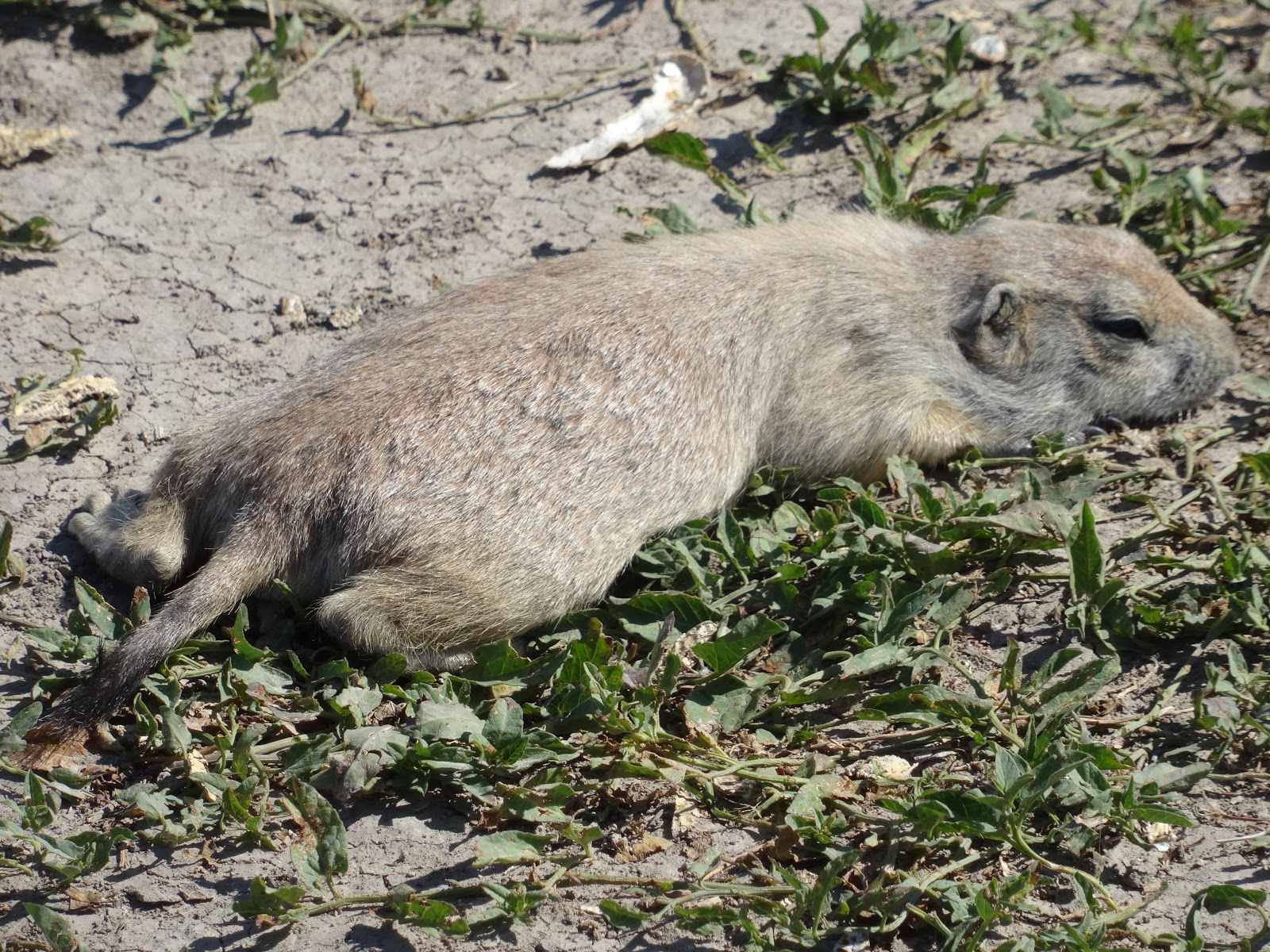
Just before entering Badlands National Park we stopped at a prairie dog town for some photos. It's always fun to hear the noise emanating from the prairie dog town. This time of year we were lucky to see the young pups running around.
 |
| Prairie exiting hole |
 |
| Young Prairie Dog |
|
|
|
 |
| Lots of Eurasian Collared-Doves in the town also. |
As you enter the Badlands the land itself changes immediately. All the way across South Dakota are agricultural fields and tall grass prairies. Suddenly, you see stark naked hills of limestone in all directions.
 |
| Entering Badlands NP from the Buffalo Gap Grasslands in background |
 |
| Something to think about while walking around |
 |
| Starkness at it best |
You just have to wonder what the pioneers thought when they came to this area for the first time. Which way do you go?
 |
| Sharon wondering around the formations. |
|
|
On the upper mesa areas there were some green areas where the land could hold water and thus some grasses and other vegetation could grow.
 |
| Rock formation that reminded us of a Prairie Dog |
 |
| Meadowlark in the vegetated area of park |
 |
| Western Kingbird | | |
|
|
 |
| The Bighorn sheep seem to live in both areas of the park |
 |
| Bighorn on the mesa |
 |
| One of only two Buffalo we saw in the park. | | | | | | | | | | | | | | | | | | | | | | | | | | | | | | | | | | | | | | |
|
|
After the Badlands we headed to the town of Custer to get our motel. On the way we passed the mountain that they are still carving out the bust of Crazy Horse.
 |
| Monument of Crazy Horse |
 |
| Our little Bavarian Motel-very nice |
After getting settled in the motel we drove over to Mt Rushmore for the evening to see the illumination ceremony to honor the veterans. During the ceremony all the veterans in the audience go up on stage and eight of them take the flag down and fold it. A while back, our older son Chris was there and he was one of the eight armed forces people to fold the flag.
 |
| Stage where ceremony is held |
 |
| Illuminated |
 |
| Washington in Profile |
 |
| Walk way to Mt Rushmore |
For tomorrow's adventure we head to Custer State Park
The
Palace, with its mad mix of onion domes and minarets, looks like it was
drop-kicked out of czarist Russia. It was originally built in 1892 to
show off the fertility of South Dakota soil and lure settlers. It was
rebuilt in 1905 and then again in 1921 -- and that version has remained
on the job ever since, luring tourists now instead of farmers.